April 13, 2007

Midelt and Sahara (4/12-13, 2007)

Our trip to Midelt started off an adventure into the lesser traveled parts of Morocco. We hiked to a small mudbrick village, visited a carpet and embroidery workshop to empower Moroccan women, and rode camels in the Sahara.

Kimberly

For photos, click here: Midelt and Sahara.

MideltSahara


Midelt

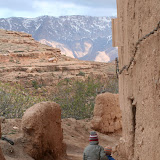
In Midelt, we visited the mudbrick village of Berrem, where relatively few foreigners visit. Still, the children had learned somewhere that tourists often bring candy…and were quick to ask for it!

We also visited the Kasbah Myriam, a carpet and embroidery workshop run by Franciscan nuns with the aim of providing sustainable employment and healthcare to local Berber women. Teenage girls start working here learning embroidery…but also how to read and write. The older women teach the younger women the traditional skills, and the nuns focus on improving their literacy. It is incredible to imagine Myriam moving here 50 years ago from France to try to improve the lives of the women in this community.

The best part of our time in Midelt was staying in an old “castle” the Auberge Jaafar! (Yes, I think he’s the bad guy in Aladdin, right?) The building was this incredible construction alone in the middle of the rugged desert—-set against a mountainous backdrop. And, of course, we enjoyed another feast for dinner. Complete with music and dancing…definitely check out the photos to see some of Dan’s skills!

Auberge Jaafar
Berrem, Midelt
+212 (0) 35 36 02 02

The Sahara

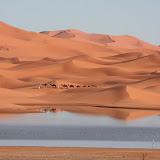
This was the quintessential North African experience…riding a camel through the sand dunes in the Sahara to overnight at a Berber camp in the desert! After a very long drive, we finally arrived at the edge of the Erg Chebbi dunes. We packed up overnight bags, put on our turbans, mounted our camels, and headed off into the desert. The scenery was breathtaking, the camel ride was too…in an exhausting kind of way. Let’s just say that riding a camel is not an especially comfortable experience!

We arrived at our campsite in the late afternoon, so I (stupidly) decided to run up the side of a sand dune to get to the top before sunset. I was hacking and coughing for the next two weeks…getting all that sand in your lungs is a bad idea! (And getting to the top of the dunes is harder than it looks…for every step you take, you slide a half step backwards!) But the sunset was beautiful.

That was just the beginning of our desert experience though. We were staying with a Berber family, who graciously cooked us all dinner and even sang Berber lullabyes to us before we went to sleep. (Click below to listen to the video...you’ll have to imagine the incredible desert sky filled with stars, my camera didn’t pick it up so well.)


The next morning, we rose before sunrise to try to catch the changing colors of the sand dunes. I do really think that something is different about the sand in Namibia, because the colors were not nearly as spectacular here. (FYI, if you’re going to visit one set of sand dunes in the world, I’d say go to Namibia…far more spectacular, and littered with far less trash. But, you can’t ride a camel through the desert or sleep in the middle of the dunes…)

And with another uncomfortable camel ride, we were back on the road, onto our next destination!

April 11, 2007

Fes (4/10-11, 2007)

If you’re going to visit only one city in Morocco, make it Fes! It’s everything you imagine when you think of Morocco: crowded Bazaars, small passageways, men working in the tanneries, mosques, old tradition…

Kimberly

For photos, click: here.

Fes


We arrived in Fes in the evening, just in time for sunset cocktails at the posh Palais Jamais hotel. The drinks were overpriced, but the view of the entire medina (old city) was incredible…especially as the evening calls to prayer echoed across the city.


After our fancy drinks, we headed off for the real treat of the night…a traditional Moroccan feast at Dar Masmoudi. This place is one of many riads: old houses that have recently been restored and converted into hotels. We would have loved to have stayed here, but just eating dinner in the traditional dining room was incredible. We started with some Pigeon Pastilla (my absolute favorite dish…fowl cooked in a pastry with almonds, eggs, cinnamon, nuts, and powdered sugar…it’s like a desert for dinner!). Then we had several more courses of vegetables, couscous, tagine, and finally dessert and tea. It was wonderful!

The next day we headed off to see the city. We started out at the Royal Palace. We could visit only the main gate, but that was impressive enough. The detail in the mosaic tile, gilded doors, and carved marble was incredible! Then we explored a little around the Mellah, or Jewish ghetto. Morocco has actually been a safe haven for the Jews over the centuries and maintained a large Jewish population until the creation of Israel. Jews started arriving in full force in the country in the mid 15th century during the Spanish inquisition. They were not fully accepted into Moroccan life and very much stayed within their neighborhoods. The Aben Danan Synagogue highlighted this interesting intersection of Jewish and Arabic influences…with mosaic tile décor.

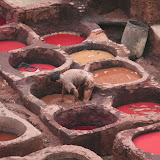
Fes is well known as a city of artisans. So we set off to visit some of their workshops and see them in action. We toured a ceramic factory and saw tagine dishes being thrown and glazed – and mosaic tiles being chipped and organized into intricate patterns. We visited a small brocade workshop…literally just a room tucked away behind a door in the medina where several men were cranking away at large rooms making beautiful fabrics. The definite highlight though was seeing the tanneries! You’ll likely recognize the tanneries in our photos from some vary famous series shown in National Geographic. The sight of men working in these large vats of both lime (to soften the hides) and dyes (to color them) was absolutely incredible!

Wandering around the medina was a feat in itself! We were very happy to have hired a good guide. We definitely would have gotten lost had we been on our own (not to mentioned hassled by all the vendors and “want to be” guides). But the most important reason to hire a guide is that we never would have known where to go on our own! Our guide would literally knock on a wooden door and take us inside to a group of metal workers, fabric weavers, or Fes makers. It was such a treat!

I highly recommend spending a few days in Fes to soak up the incredible sense of history, culture, and Moroccan daily life!

Dar Masmoudi
Tel 212 (0)35 63 56 85
www.darmasmoudi.ma
darmasmoudi@menara.ma
darmasmoudi@yahoo.fr
3 Derb El Meter, Zenjfour, Fes
(near Palais Jamais)

April 10, 2007

Meknes & Volubilis (4/10, 2007)

Morocco is an exotic melting pot. The mix of African, Berber, Arabian, and French cultures make for an amazing history. Each city & village we visited on tour had a story to tell and images to share. Overwhelming and dizzying medieval Kasbahs in every city centre contrast the vast array of pristine natural landscapes. Our next stop on our trip was the city of Meknes and the Roman ruins in Volubilis.

Daniel

For photos click here: Meknes and Volubilis

MeknesVolubilis


Meknés
Before exploring the Meknes city centre or medina, we stopped in a local shop for some fresh OJ (highly recommended). We soon realized what fresh really means – and for about 20 cents it was especially delicious. We also sat down in the same one-table shop and were eagerly served some creamy yogurt (we think another French influence) by the shop owner’s young assistant.

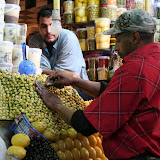
During some free time, we encountered another beautiful example of Moroccan gate architecture. Meknes was a vibrant city with an even more vibrant Kasbah. In this case, the medina is home to a sprawling street market that is tightly packed into the alleyways. Seb, smartly led us around the market where we found luscious olive displays, chicken vendors where they literally weighed, killed, and de-feathered your chicken (not for the faint of heart). Sometimes, we needed to be careful about taking photos – so as not to offend people. However, the men working the chicken shop really enjoyed being behind the camera. As we rambled on, we encountered iron work shops, tempting pastry vendors, fruit vendors, and even raw wool sellers. As promised by Seb, we finally found the “camel meat guy”. We paid for a choice cut of meat and watched the camel guy (who, in my opinion, had the best shop set-up in all of the medina) grind and season the meat to perfection. We then took our goods to a nearby shop where the owner runs a public grill – for a small fee he cooked up a lunchtime feast. Within 15 minutes we were packed into a hidden room across the alley from the grill, around a table laid out with tasty camel burgers and hot mint tea.

The market was also proudly local, as most of the business was not done for tourists. Rather we were just some visitors passing through with a fantastic chance to experience their daily routine. Although, there were other tourists wandering around Meknes – many of the people inside the medina were there to do business.

Another random highlight, global brands gone mad…it’s always fun to find brands that you recognize in far away lands. It’s even more entertaining to find “similar” knock-offs in unexpected places – like a local street vendor in Meknes.

Here is a video of the metalworkers in the souk (market).


Volubilis
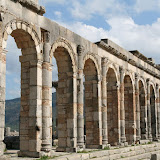
An ongoing theme throughout our travels has been the vast Roman influence. No big surprise, they were big in Morocco too. This site was highlighted by intact aqueducts, beautiful wild flowers, towering columns, intricate mosaic floors, and tons of Roman olive presses. Volubilis is believed to have been a Roman industrial hub in Africa. The remarkable ruins revealed signs of a complex olive industry that probably explained the importance of Volubilis in Roman times.

To provide some scale, many of the standing columns have become the nesting grounds of storks. Their nests are enormous but only look like small caps atop the soaring columns.

The other noteworthy item was a large carved stone placed at the center of a small room. The carving on the top of the stone is clearly…well, look at our photos and you can decide for yourself. Explanations: The original men’s room sign, or a sign of the hedonistic Roman culture & lifestyle.

April 9, 2007

Casablanca & Rabat (4/9, 2007)

This was one of the few trips where we went on an organized tour (Intrepid Tours – Colours of Morocco: www.intrepidtours.com/trips/XSC.) Given the vast number of destinations, it was a very wise decision. We roughed it a little more than we prefer, but the sites and experiences were worth every cold shower & uncomfortable train ride. We began our journey in one of the most well known Moroccan cities, Casablanca -- and then onto Rabat.

Daniel

For photos, click here: Casablanca and Rabat


Casablanca, MoroccoRabat, Morocco


Casablanca
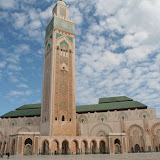
The starting point for our Moroccan adventure was not the whitewashed Casablanca that has been immortalized my American films. Casablanca is the modern-day financial & industrial capital of Morocco. The city only had one main tourist site, the Hassan II Mosque – one of the largest mosques in the world. It was built by and dedicated to King Hassan II. The foundation was designed so that the mosque literally towers over the Mediterranean Sea. We only spent a half day touring the massive complex. Some photos highlight the pure extravagance of every detail. The Ceiling is a massive retractable roof that puts most sports domes to shame – every inch is carved and decorated with beautiful colors and relief patterns.

Our guide & group leader, Sebastian, quickly got the party of 12 travelers packed into a van, in route to the train station, and on our way to Rabat. Seb, as we got to know him, was originally from Canada and lived in Vietnam. He was actually heavily involved in launching the Intrepid Tours in Morocco, so many of our destinations were truly personal and unique – much more so than we could have gotten by just following guide books and public knowledge.


Rabat
After stashing our luggage near the Rabat Train Station, we spent the afternoon exploring the “new” and “old” town. As we quickly learned, the French had a huge influence on Morocco culturally and architecturally. Most cities have an ancient center known as the medina where most of the interesting historical buildings and landmarks are found. In Rabat, the train station is located near the nouvelle place complete with wide boulevards (reminiscent of Paris). The towering palm trees lining the main street were perfectly aligned and placed. All planning & design disappear once we set foot in the medina, the streets were a crooked, confusing maze – they developed organically as the town grew in size. Nothing is balanced or anything faintly resembling a grid. Once inside, we discovered narrow, whitewashed alleyways and sunlit gardens. We also eventually found (after at least a ½ hour of getting lost) the Bab er Rouah or “Gate of Wind” – a masterful display of relief work and ornamentation around a functional gate. Behind the gate was a lush garden with views of the medina walls, which were dotted with intricately painted doors. Rabat filled the void where Casablanca left us short.

In order to get to our next destination, Meknes, we had to endure a tough train ride. Our group reassembled at the train station, which was slowly turning into a mob scene. The single train platform was filling up with mostly locals waiting for the train. Seb, repeatedly reminded us that this was a pure free-for-all. As soon as the train arrived we were to pile ourselves into the closest car door. As our train pulled to a stop, we were all tense for the impending chaos. After all, if we missed this train (according to Seb) the next train wasn't until the next morning. So we frantically threw ourselves into the crowds of passengers. After squeezing ourselves and our luggage onto the car – Seb had to push himself through the packed train cars to make sure everyone had actually gotten on the train! After, another minute he made the count – we were off to Meknes.

March 31, 2007

Paris March (3/1-31)

Such an exciting month! We (finally) visited the Louvre, took a Jazz cruise on the Seine, enjoyed a picnic at the Eiffel tower, had a good friend, Sebastiaan, in from Amsterdam, and discovered the amazing Musee des Arts decoratifs and Musee Nissim Camondo.

Kimberly

For photos, click here.

Paris in March


After months of living in Paris, we finally really got around to sightseeing! This was the month when we finally visited all the museums we had talked about for months and explored the parks an neighborhoods we kept hearing about. The fact that spring was finally starting to come probably had quite a bit to do with it...and that we had yet more visitors!

Musee du Louvre: Neither of us really like the Louvre, but it's one of those things that you just really need to see in Paris. Perhaps it's because it is so large and overwhelming? Certainly because it's just not our style of painting (we much prefer the Impressionism in the Orsay)? And definitely because it is usually so crowded! Should anyone be planning to visit the Louvre, I have two recommendations for you. 1) Choose the day you go wisely: Don't go on Tuesday, as it is closed. But don't go on Monday (when all the other museums in Paris are closed...because everyone has the same idea). We went on a Wednesday, and it was practically empty! 2) Don't try to do the whole museum. Choose a wing, a style of art, or something special you want to see -- and limit it to that. Or, take a walking tour of the museum that focuses on the highlights. We downloaded Rick Steves audio guide off his website (www.ricksteves.com/news/travelnews/0602/audiotour.htm) (you can also get it off iTunes) and found the commentary to be quite good at giving context to the works and bringing the installations to life.

Musee d'Orsay: This is both of our favorite museum in Paris. We love Monet, Manet, Renoir, Van Gogh...so that is a big part of it. But also the building itself is just amazing. They converted the old train station, Gare d'Orsay, into this incredible museum. A monument to the Industrial Revolution, the Orsay is covered by an arching glass roof allowing in floods of light. They even left parts of the station and attached hotel in tact, the heart of the museum is the restored main station (complete with its clock) and you can enjoy coffee, tea, or lunch in the hotel's grand dining room!

Musee des Arts Décoratifs: There will probably be many other sights on your list before you can get here. But if you are interested in furniture or interior design, don't miss this place! It is attached to the Louvre, but with a separate entrance (and far fewer visitors). The audio guide is very engaging and provides a really good overview of the history of French furnishings from medieval times through today. The highlight for us was when we were exploring the "contemporary" furniture section where they had hundreds of different chairs on display from the 50s-70s...we looked over and saw a chair that we swear my family has. (They are the plastic chairs that the Haimsohns lend and borrow from each other for big family dining occassions.) Too funny!

Musee Nissim de Camondo: We had never heard of this museum, and we had lived here for several months...but what a hidden jewel it is! This has become one of my favorite museums in all of Europe, as it does a great job of conveying the life and decor of the 18th century. The museum is was the home of an aristocrat -- rich with needlepoint chairs, tapestries (many from Beauvais or Aubusson), antiques, paintings, bas-reliefs, silver, Chinese vases, crystal chandeliers, Sèvres porcelain, Savonnerie carpets, and even an Houdon bust. The pre-World War I town house was donated to the Musée des Arts Décoratifs by Comte Moïse de Camondo (a Jewish banker) in memory of his son, Nissim, a French aviator killed in combat during World War I. (Highly recommend a picnic or walk around the nearby Parc Monceau before or afterwards!)

I also surprised Dan with a jazz cruise on the seine. Every Wednesday evening, the Melody Blues has a jazz cruise with different live music. You can go for just drinks or also for dinner (which is kind of mediocre). But the experience of listening to live jazz while cruising by floodlit Parisian buildings and monuments was really cool! www.melodyblues.com (Porte de Bercy, 75012 Paris - Tel 01 56 95 03 15)

We also were lucky to have a good friend come visit from Amsterdam. Sebastiaan went to school with me at the Stanford GSB and also works at Bain (the company that I worked for before school...and will go back to once this dream year is over). We had been talking about visiting each other for months -- and this month we made it happen. We went to see him in Amsterdam, and he came to visit us in Paris. So much fun to show visitors around such a great city!

We also just walked around and enjoyed the lovely Parisian spring. Definitely take a look at our photos, as we have some nice shots of everyday Parisian life: children playing in the Champ de Mars on a Sunday, rugby fans standing outside a bar in the 4th watching "Six-Nations," Zookie in a cafe on Ile St. Louis...

And now, my commentary for the month:

I have already referenced one of my favorite books on the American experience in France, Paris to the Moon, by Adam Gopnick. During his time in Paris, he (to his own surprise) ended up not only participating in, but somewhat spearheading an infamous group that created quite a legend of the French passion for food and antipathy towards business people, corporations, and things seen as American.

As a writer, Adam found company in the Brasserie Balzar in the 5th arrondissement when he moved to Paris. He was welcomed into the French club (surprising as he was an American) and joined forces with the other regulars when the Balzar was bought out by a chain of Parisian restaurants, the Flo Group.

The business model of the Flo Group typifies everything "American" about business -- they buy up restaurants, find ways to make them more efficient, cut costs, simplify the menu....and make more money. (but usually taking away the character of the place that made it special to begin with) The tension between the traditional, family owned and run, restaurant and the corporation seeking profit exemplifies the stereotypicial tension in Paris between things seen as French and those seen as American. The French hold onto their traditions and idealize them, while putting down anything seen to represent change, modernization, and (god-forbid) profit/money. This is obviously an over-simplification...and there definitely is something to be said for all the wonderful restaurants that have lost their soul due to the search for profit. But I do feel that it summarizes the tension that the French people feel towards America, Globalization, and Capitalism today.

After the Flo Group announced their takeover plans for the restaurant, a group of regulars, which included author Gopnick, banded together to create Les Amis du Balzar (the friends of Balzar) and literally organized ambushes of the restaurant to force the new prospective owner to meet with them and make concessions about how the Balzar would be run after the purchase. Only in France...really, only in France! I'm really not kidding about this, to read more, here is an article from the International Herald Tribune, titled the "Struggle for the Soul of a Parisian Restaurant" www.iht.com/articles/1998/08/08/balzar.t.php

Gopnick, as member of Les Amis du Balzar finds himself torn at times between empathizing with his colleagues passion to "save the soul" of the brasserie and understanding the mechanisms of the market and realities of business. The guy is a New Yorker... Here are some words from his book, Paris to the Moon, on the topic, especially the French love-hate relationship with America:

"The anti-Americanism that lent a piquant, alarming note to the Balzar wars had been as anti-Americanism most often is in France, not quite real, an abstract idea, a speech act with very few barbs in it. Anti-Americanism in France at the end of the twentieth century is in fact in some ways like anti-Catholicism in England in the nineteenth century. It is a powerful, important, influential, official doctrine, but it is also not entirely real: English people imprecated against the Catholics and the Pope, but that didn’t stop them from loving Venice, traveling to Florence, worshipping Raphael, and filling their houses with Italian pictures. Even the much-publicized fusses about American mass-produced food and French peasants “trashing” McDonald’s are almost pure media events. The French farmers knock down a McDonald’s for the benefit of the French media, which publicize it in Le Monde in order to see what The New York Times will have to say about it the next day. Anti-Americanism has enormous life as an abstract ideological principle and a closed circle of media events of this kind, but outside of a tiny circle on the elite left and, surprisingly, a slightly larger one on the elite right, it has almost no life as a real emotion..."

Now, the good stuff, restauarants!!

Brasserie Balzar
www.brasseriebalzar.com
49 rue des Ecoles - 75005 Paris - 01 43 54 13 67
(If you are looking for an authentic, mediocre, Brasserie meal, this place will hit the spot. But it is just that...mediocre (meaning average, nothing special, not bad, just not great). And it's quite expensive for what you get. But come on, we had to eat here after hearing about the story of Les Amis de Balzar and their fight to save the soul of the restaurant!)

L'Os a Moelle
3 rue Vasco-de-Gama - 75015 Paris - 01 45 57 27 27
(A remarkable place, well worth the trek down to the 15th. Even if we did have trouble along the way as the metro broke down due to a "situation grave" (a serious situation). The six course prix-fixe menu for 38 euros has to be the best deal in all of Paris...especially for such gourmet, beautifully presented, and incredibly delicious food. Highly recommended.)

Le Fumoir
www.lefumoir.com
6 rue de l'Amiral Coligny - 75001 Paris - 01 42 92 00 24
(If you are looking for a trendy restaurant where all the hip, young Parisians go...then look no further. It was quite a difference from the crowd we had joined for dinner the previous night at L'Os a Moelle, but refreshing to be around some folks are own age. :) Seriously this place has quite a reputation for not only cool ambiance and the "in-crowd", but also for some great food. Our experience at brunch definitely confirmed that. Eggs benedict, pancakes, fresh orange juice, coffee, and a bread basket for 22 Euros...I can think of worse ways to spend a Sunday morning/afternoon in Paris!)

La Flore en Ile
42 quai d’Orléans - 75004 Paris - 01 43 29 88 27
(A beautiful, traditional cafe on Ile St. Louis, this is a great place to spend an afternoon sipping coffee and enjoying one of their great cakes or pastries.)

Cafe Laurent
www.cafe-laurent.com
33 rue Dauphine - 75006 Paris - 01 43 29 03 33
(OK, not a restaurant, but a really cool bar/lounge where you can hear live Jazz on Thursday, Friday, and Saturday evenings. Inside the Hotel d'Aubusson, a great kind-of pricey, but not too bad for Paris, hotel right around the corner from our apartment in the 6th.)
March 30, 2007

Provence (3/30-4/2)

Roman ruins, wine tasting, the Papal Palace...and a French bullfight (think more like tag with a bull)! Read below for the fun exploits of our long weekend in Provence!

Daniel

For photos, click here:

Provence


After another fun TGV train ride with Zookie in tow, we found our quaint hotel in the town of Arles. The owners were friendly and happy to offer dining recommendations (it helped that we could speak a little French). Plus, the coffee was fantastic! Hotel du Musee

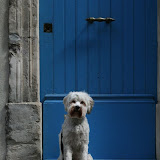
One of the best parts of being in Arles was wandering the streets and alleyways. Scattered around town are copies of various paintings by Van Gogh while he lived in Arles. It's easy to see how he was inspired by the local cafes and squares. The colors are still vibrant - we found a bright blue door down a narrow street. It was a perfect photo opportunity for Zookie.

An unexpected highlight was the ancient colosseum that sits at the center of town. Amazingly intact for its age, the colosseum is beautiful to walk around and admire the architecture. The best part - they still have bull fights inside. Of course we found a way to catch the Sunday showing. The majority of bull fights are very different from the typical blood and gore killing fest. Rather than a one-on-one showoff, two teams of locals challenge each other. The goal: grab the ribbon (which is tightly wrapped around a bull's horns) and race to safety beyond a wooden barrier without getting trampled by the bull. It was fun to watch and interesting to learn about the history behind the game.

During the action (we watched the teams try to get the ribbon on 4 different bulls), the overhead speakers blasted out Carmen whenever the bull made an extraordinary move or chase. Also, in the background a man's voice rattled off numbers and names, which apparently were wealthy spectators offering bets if one of the players could grab the ribbon at that instant. Essentially, a little motivation for the men on the field to get aggressive. Finally, when time ran out Carmen would come on and the bull would proudly trot through the main gate. A fantastic way to spend the afternoon.

Here are two short videos to give you an idea of how the Course Camarguiase works: http://video.google.com/videoplay?docid=3078201512749035185&hl=en and http://video.google.com/videoplay?docid=-8114115027640534373&hl=en

One day, we took a quick daytrip to Avignon, to see the Papal Palace. This was the residence of the Pope from 1309 to 1403. It originally came to be when Pope Clement V was elected. Italy had been unstable and somewhat dangerous for a while, so the idea that it may be best to leave the Vatican wasn't so crazy....but only a Frenchman would really have the audacity to suggest that the entire head of the Catholic Church be moved to his homeland. As if that weren't enough, when Pope Gregory XI moved back to Rome in 1378, that should have been the end of the Avignon papacy. But after he died, the French decided they were in charge now, and recognized their own Pope instead of the one in Rome. Hence the great Papal Schism: during which there were actually two Pope from 1378 until 1417. Crazy!

On our last day, I finally braved it and we rented a manual car. We had wanted to explore the French countryside, specifically the Cote du Rhone wine region. I needed to finally learn how to drive stick, especially because we were planning a trip to Turkey (where, in some regions, you cannot even find an automatic car). So we decided this was the best time and place for a nice little adventure. All-in-all, it wasn't so bad. I somehow managed to drive the car for two hours before stalling it once -- but after that first stall I had quite a bit of trouble. I think Kim's text message (stating no stalls yet) to our friend was the fatal jinx...Thank god France has so many roundabouts!

Touring the countryside was a wonderful way to really get a feel for the region. The small cities of France are full of character and each their own, but once you get out into the more rural towns, it is a completely different feel. We visited Les Baux, a beautiful city with a castle perched right on top of white cliffs. The view of the surrounding olive groves and vineyards was amazing.

I had been looking forward to wine tasting for months, especially as Cote du Rhone wines are my favorite. We visited several caveaus (local wine store for the town) and some vineyards and wineries. The small town of Gigondas has an excellent caveau, and Zookie could even join us on our tasting quest! We also tasted at Domaine de l'Amandine in Seguret and Didier Charavin's place in Rasteau. The French are much more laid back about their wine tasting than we are in Napa or Sonoma. There is no tasting fee, no fancy tasting room, and far fewer people rushing from winery to winery. And the purchase process is completely different too -- bottles, of course, are much cheaper. But you can also just bring a large jug or container to the winery and they fill fill it up directly from the tap! (I think that has to be illegal in the United States or maybe Two Buck Chuck is working on it)

Our last stop on our countryside adventure was the old Roman aqueduct, the Pont du Gard. It was built as the critical link of a 30 mile canal that supplied nine million gallons of water per day to Nimes -- one of ancient Europe's largest cities. The remaining part of the aqueduct spans a canyon like a massive bridge, and is actually the second-highest standing Roman structure. (Rome's Colosseum is only 2 yards taller.) A feat of engineering, especially when you remember that this was built thousands of years ago.

Restaurants: The food in Provence is amazing. We actually liked the restaurants here better than most of the places we had tried in Paris. It's a different style of cooking, based on olive oil (not butter, which is the style in Paris) and very fresh ingredients and herbs. Oh, and your value for money goes much farther here. (Think 25-50% less than Paris prices.)

L'Entrevue
(Place Nina Berbenova - 13200 Arles Tel: +33 (0)4 90 93 37 28)
www.restaurant-lentrevue.com
Kimberly had eaten here six years ago when she came to Europe with her best friend after college. She had been raving about this Moroccan restaurant for years: as it was the first place she tried pastilla. It is a pie which combines sweet and salty flavours. Made with a crust that is similar to the Greek phyllo pastry, it is stuffed with pigeon (sometimes chicken), almonds, sugar, vanilla, and cinnamon. It was pretty amazing (as was my couscous).

Lou Caleu
(27 Rue Porte de Laure 13200 Arles Tel: 33+ (0)4 90 49 71 77)
www.restaurant-lou-caleu.com
If you are looking for a traditional Provence meal, look no further. This is probably the best place to try Gigotin de lapereau roti aux jus d'herbes et son ail confit (leg of young rabbit roasted in an aux jus herbs sauce with a garlic confit) or longe de cochonnet de lait laqué au miel d'oranges douces (loin of young milk-fed pig laquered in orange-flower honey). In provence, the meat will taste more flavorful and flowery even with the same cooking preparation as other parts of France -- because the animals are fed a diet of flowers and herbs to give them a different flavor from within. We enjoyed a great lunch here. But take note, the menus are in French only...and our waiter didn't speak enough English. (So we ended up serving as translators for the many Americans in the restaurant!)

La Cigaliere
(53, Rue Condorcet 13200 Arles Tel: +33 (0)4 90 96 56 20)
www.restaurant-la-cigaliere.com
This place is just exceptional. Again, wonderful fresh food in the Provenve cooking style. Come hungry!

La Paillote
(28, Rue Doct Fanton 13200 Arles Tel: +33 (0)4 90 96 33 15)
We enjoyed a great Provence meal here as well. It was surprisingly empty, which meant we got the chef's attention all to ourselves. I think it was relatively new, so that may have explained why it was so quiet. The prix-fixe meals were a really good value.

March 27, 2007

Amsterdam (3/24-27)

We spent a long weekend in Amsterdam visiting a good friend Sebastiaan, from both Stanford and Bain. It was a real treat to have a local show us around this beautiful city and surrounding countryside. Yes, canals, windmills, and pancakes it was! (Though we did also visit the Red Light District one afternoon.)

Kimberly

For photos, click here.

Amsterdam


We had been planning to visit Amsterdam for months. Dan had never been to the city, and I hadn’t been there since my first trip to Europe with my grandparents when I was 12. But the real treat was that we were visiting our good friend Sebastiaan, who I became very good friends with at Stanford and is also a Bain & Company consultant (for the Amsterdam office).

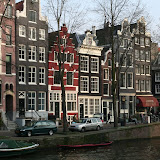
Sebastiaan lives in an adorable apartment just north of the Vondelpark in a quiet part of the city that is still full of character. In some ways the area reminded us of Lincoln Park in Chicago, probably because so many of the houses were brick. But a striking difference is that all the houses here have different gables on top. Needless to say, the entire city was rather picturesque.

Our first afternoon, Sebastiaan took us on a walking tour of the city and its various neighborhoods. Yes, we did venture into the Red-Light District…and yes, it was quite odd to see prostitutes standing in their windows advertising their services in the middle of the day. We had an amusing discussion wondering how exactly the process works…do you just negotiate? Is there a price-list?

The Netherlands has a tradition of “looking the other way.” They are an incredibly tolerant country, as long as they don’t see “it.” This tolerance applied not only to drugs, prostitutes, and Jews (during the 16th-19th centuries)—but also to Roman Catholics after the Reformation. Catholics were officially allowed to stay in the country, but they couldn’t practice openly or have cathedrals. Thus, the “Secret Church in the Attic,” which Sebastiaan took us to. This amazing little church is actually hidden on the upper floors of a canal house. It must have been an architectural feat to create such a large open space in such a small, old building.

On Sunday, Sebastiaan took us to the countryside south of Amsterdam to see a bit more of the country. We visited the Haarzuilens castle, which is the largest remaining castle in the country. The grounds are enormous too…and Zookie truly enjoyed himself wandering around them. And an added treat…Sebastiaan graciously taught Dan how to drive a stick-shift on his car in the parking lot of the Castle. I know it’s really silly that neither of us know how to drive a manual car, but we really have never had a chance to learn. Sebastiaan was a great teacher—so now, hopefully, we won’t have to pay extra to rent automatic cars anymore!
After our adventure at the castle (and in the parking lot), Sebastiaan took us to a favorite place from his childhood for Dutch pancakes! I can’t quite explain how they are different from American pancakes, but imagine something in between a pancake in the U.S. and a crepe in France. And then there are fillings that are baked into the batter. We had bacon, cheese, and apple pancakes… yummy! If you are in the Netherlands, you must try them!

On Monday, Sebastiaan had to work, but he sent us off with plenty of things to explore. We first visited the Van Gogh Museum, with its impressive collection of paintings by this amazing artist. I had completely forgotten that he was completely self-taught and painted for only ten years before he committed suicide at the age of 37. After an incredibly tasty lunch at Buffet van Odette & Yvette (see below), we set off for the Anne Frank House. Dan and I were both incredibly moved by physically being in this space where Anne wrote her famous diary. I hadn’t realized how influential her book was, that it inspired people like Nelson Mandella during his prison time on Robben Island, and that it had been translated into more than 50 languages.

We spent the rest of our time walking along the canals, admiring the quaint houses, and eating very well. We found the food in Amsterdam to be incredibly good…and cheap compared to Paris! (Really, I think Paris is about 25% more expensive for eating, and the food is often of significantly lower quality.) Any visitor here should definitely go to a bar for a drink and some Dutch snacks. Our favorites were Bitter Balls (kind of like a Spanish croquette…deep fried mashed potatoes and bits of meat and gravy), Cheese Sticks (again deep fried, but Gouda), and Applecake. Sebastiaan also made sure we had a traditional Dutch breakfast one morning, which consisted of slices of bread with either his favorite cheese (Zaanlander Extra Belegen—similar to a Gouda, but tastier!)

RESTAURANTS:

Villa Zeezicht (Torensteeg 3) –Great applecake! Also very good sandwiches.

Buffet van Odette & Yvette (Herengracht 309)—amazing sandwiches! Goatcheese, honey, and thyme…

Harkema (Nes 67 - 020 428 2222) –amazingly large restaurant that is a very stylish converted warehouse. Very trendy place for dinner.

Paso Doble (Westerstraat 86 - 020-4212670) http://www.dobson-uzcudun.com/tapas/pasodoble-en.htm Really good authentic Spanish Tapas.

De Bakkerswinkel (Warmoesstraat 69, Roelof Hartstraat 68, & Regulateurshuis 1, bij entree ophaalbrug Polonceaukade 1) http://www.debakkerswinkel.nl/ Amazing sandwiches and really tasty afternoon tea! come between 2-4pm, and then you can order off both the lunch and tea menus!

Brix (wolvenstraat 16 - 020 639 0351) – bar with great “tapas” style food (meaning small plates)...trendy scene with very global cuisine Live music many evenings

Viaamse Friethuis (Voetboogstraat33) – Famous for the best French fries in town (served with mayonnaise…or another sauce of your choice.)